Technical Guides
Acrylic in Signage: Thickness, Expansion and Material Selection
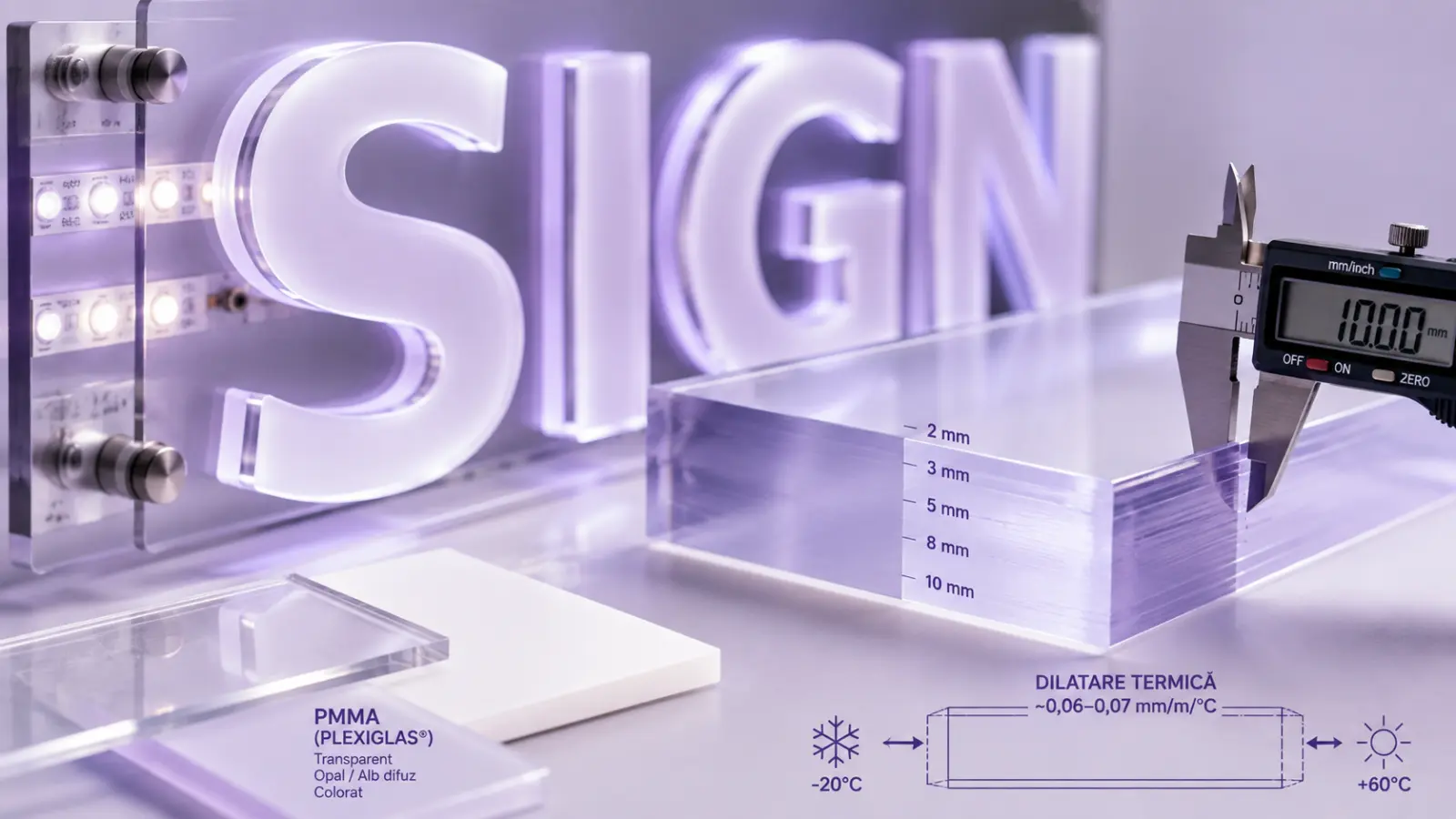
Acrylic (PMMA) is widely used in signage because it can be clear, coloured or light-diffusing and can be processed accurately by CNC or CO₂ laser. The correct grade and thickness depend on the function of the part, not only its visible dimensions.
Thickness is a structural and optical decision
A thicker sheet can increase stiffness, but thickness also changes weight, edge detail and, in illuminated applications, optical behaviour. The panel size, support spacing, forming or routing operations and fixing method need to be considered together.
Thermal expansion matters outdoors
PMMA expands and contracts noticeably with temperature. A commonly used engineering value is roughly 0.07 mm per metre per °C. Across a two-metre element and a 50°C temperature change, movement can therefore approach several millimetres. Fixing holes, channels and captured edges need enough allowance so the sheet is not locked rigidly against this movement.
Cast and extruded acrylic
Cast and extruded PMMA can behave differently during machining, laser processing, forming and bonding. The choice depends on thickness tolerance, finishing requirements and the fabrication process used for the specific component.
Acrylic for LED diffusion
In illuminated letters and signs, opal or dedicated light-diffusing acrylic needs to be considered together with LED optics and distance. Too little depth or unsuitable diffusion can reveal hot spots even when the material looks sufficiently opaque when unlit.
Mounting details are part of material selection
Outdoor acrylic should be fixed with appropriate clearances and compatible hardware. The most attractive material is not automatically the correct choice if the construction prevents expansion, drainage or future service.
Have a project in mind?
Send us the brief, location and expected deadline.